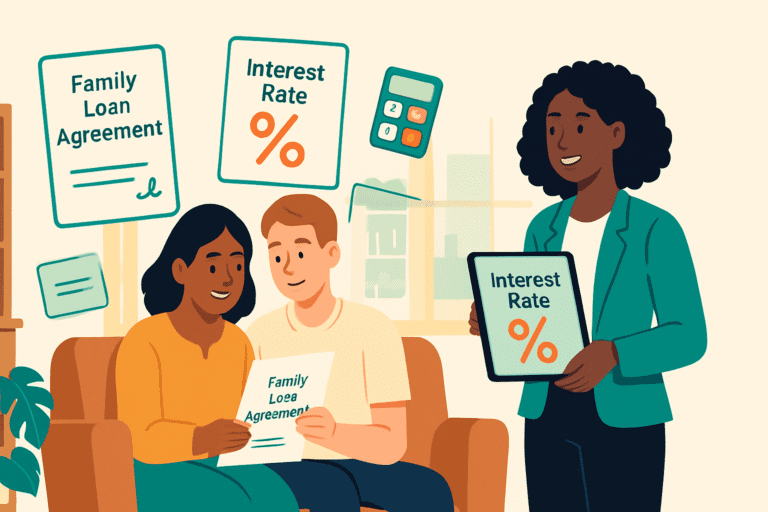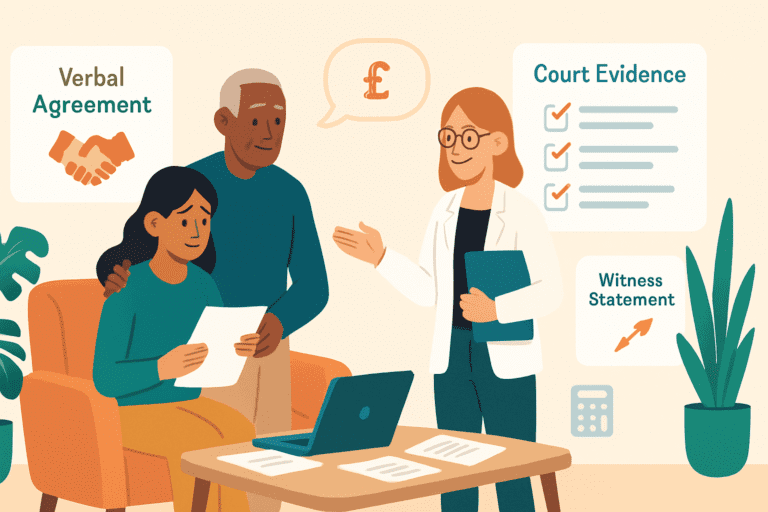
Lending money to someone you love is one of the quickest ways to destroy a relationship. Not because the act itself is wrong, but because most people do it on a handshake — and handshakes have a terrible track record when memories diverge, circumstances change, or someone dies unexpectedly. If you’re going to lend money to family or friends, a properly drafted loan agreement isn’t optional. It’s the single best thing you can do to protect both the money and the relationship.
Why a Written Agreement Matters More Than You Think
Under English law, a verbal loan is technically enforceable — but proving one exists, let alone its terms, is a nightmare. Without written evidence, you’re left arguing in the County Court about what was said over a kitchen table three years ago. Judges hear these cases constantly, and they’re often deeply unimpressed by both sides. A written loan agreement eliminates ambiguity about the amount, the repayment schedule, whether interest applies, and what happens if things go wrong.
There’s a harder truth here too. HMRC takes an active interest in money moving between individuals. Unexplained transfers can trigger questions about whether the sum was a gift (with potential inheritance tax consequences) or undeclared income. A loan agreement creates a paper trail that satisfies HMRC’s curiosity before it becomes a formal enquiry.
Essential Terms Every Agreement Must Include
A loan agreement between individuals doesn’t need to be 30 pages of legalese, but it does need to cover specific ground. Miss any of these and you’re building on sand:
- Full names and addresses of both lender and borrower. Use legal names, not nicknames.
- Date of the agreement and the date funds will be (or were) transferred.
- Loan amount — stated in both figures and words to avoid any dispute.
- Interest rate — if you’re charging one. State whether it’s simple or compound, and the annual percentage. If interest-free, say so explicitly.
- Repayment schedule — monthly, quarterly, lump sum on a fixed date, or on demand. Be specific about amounts and due dates.
- Late payment provisions — what happens if a payment is missed. A defined grace period and any penalty interest should be spelled out.
- Default provisions — the nuclear option. Define what constitutes default (e.g., two consecutive missed payments) and the lender’s remedies, including the right to demand immediate repayment of the entire balance.
- Prepayment clause — can the borrower repay early without penalty? Usually yes in a family arrangement, but state it.
- Governing law — specify the laws of England and Wales (or Scotland/Northern Ireland if applicable).
- Signatures and date — both parties must sign. Having an independent witness sign too significantly strengthens enforceability.
Execute It as a Deed — Here’s Why
Most online templates produce a simple contract. That’s fine, but there’s a powerful reason to go further and execute the agreement as a deed. Under the Limitation Act 1980, the limitation period for enforcing a simple contract is six years. For a deed, it’s twelve years. If you’re lending a significant sum with a long repayment horizon — helping a sibling buy a car, funding a child’s house deposit — a deed gives you double the enforcement window. To qualify as a deed, the document must state clearly that it is executed as a deed, be signed in the presence of an independent witness who also signs, and be delivered (handed over or posted) to the other party.
Interest: The Tax Trap Nobody Mentions
If you charge interest on a private loan, that interest is taxable income. You must declare it on your Self Assessment tax return. Many family lenders either don’t know this or assume small amounts don’t count. They do. HMRC has no de minimis threshold for interest income — every penny is reportable.
Conversely, if you lend a large sum interest-free, HMRC could theoretically treat the forgone interest as a gift for inheritance tax purposes under the “transfer of value” rules, particularly if the lender dies within seven years. In practice this is rarely pursued for modest loans, but for six-figure sums it’s worth taking professional advice.
The Inheritance Tax and Gift Problem
This is where family loans get genuinely complicated. If you lend £50,000 to your daughter and she never repays it — or you informally write it off — HMRC may treat the outstanding balance as a potentially exempt transfer (a gift). If you die within seven years, it falls back into your estate for IHT calculation. The loan agreement itself helps here: it proves the money was a loan, not a gift, provided repayments are actually being made. A loan agreement with no repayments ever collected looks like a gift dressed up in a contract, and HMRC will treat it accordingly.
If the borrower dies first, the outstanding debt becomes a liability of their estate. Your loan agreement is the proof that their executors owe you money before distributing assets to beneficiaries. Without it, you may find yourself at the back of a very long queue — or shut out entirely.
Securing the Loan
For larger sums, consider whether the loan should be secured against an asset — most commonly property. A legal charge registered at HM Land Registry gives you a creditor’s interest in the borrower’s home. This is standard practice when parents help children with house deposits and want the money protected if the child later divorces or sells. Registering a charge requires a solicitor and the borrower’s mortgage lender must usually consent, but the protection is significant. An unsecured five-figure loan to a family member who later goes bankrupt will leave you as an unsecured creditor, behind HMRC, behind secured lenders, and likely recovering pennies in the pound.
What Happens When Things Go Wrong
The uncomfortable reality is that pursuing a family member through the courts is emotionally devastating even when you’re legally in the right. Before lending, ask yourself honestly: if this person never repays me, can I absorb the loss financially and emotionally? If the answer is no, either don’t lend the money or insist on security.
For sums up to £10,000, the small claims track in the County Court is relatively straightforward and doesn’t usually require a solicitor. For larger amounts, you’re looking at the fast track or multi-track, with legal costs that can dwarf the original loan. A well-drafted agreement with a clear default mechanism — and ideally a mediation clause requiring both parties to attempt resolution before litigation — can prevent things reaching that stage.
Severability and Entire Agreement Clauses
Include a severability clause stating that if any provision is found unenforceable, the remainder of the agreement survives. Also include an entire agreement clause confirming the document represents the full understanding between the parties. This prevents the borrower later claiming there was a separate verbal agreement to waive repayment or extend the term indefinitely.
Practical Steps to Get This Done Properly
For loans under roughly £5,000 with simple terms, a well-drafted template executed as a deed, witnessed properly, is usually sufficient. For anything above that — or where property, business interests, or complex family dynamics are involved — pay for a solicitor to draft or review the agreement. A few hundred pounds in legal fees is trivial compared to losing tens of thousands with no recourse.
Transfer the money by bank transfer, never cash, so there’s an auditable trail that matches the agreement date and amount. Keep signed originals in a safe place, give copies to both parties, and if you’re charging interest, set a calendar reminder to declare it each tax year. Finally, treat the agreement as a living document: if you agree to vary the terms — say, pausing repayments for six months — put that variation in writing too, signed by both parties. Informal verbal amendments to formal agreements are a litigation goldmine for the wrong side.
Lending to people you care about is an act of generosity. Documenting that loan properly is an act of wisdom. Do both.
Disclaimer: The information provided in this article is for informational purposes only and should not be considered financial or legal advice. Property and lending laws in the United Kingdom vary and may change over time. We always recommend consulting with a qualified solicitor and mortgage broker before entering into a property purchase or financial arrangement with another party.