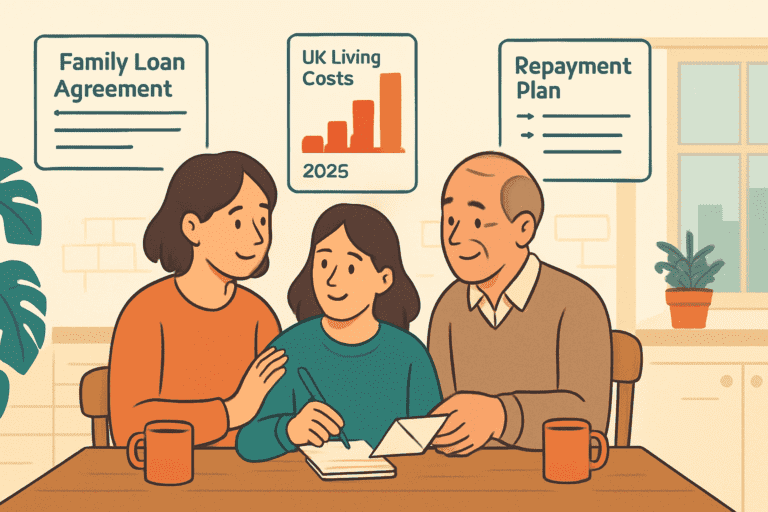
If a family member asks you to help fund a house purchase, your instinct will be to say yes. That instinct could cost you your retirement, your relationship, or both. Every year, thousands of families across the UK lend significant sums — often their life savings or equity release funds — without understanding the legal, tax, and practical consequences. This article sets out what you genuinely need to know before a penny changes hands.
The Single Biggest Mistake: Treating It as Informal
When money flows between family members for a property purchase, the default legal presumption in England and Wales is that it’s a gift — not a loan. This is the presumption of advancement, and it means that without clear written evidence to the contrary, you may never get your money back. Courts will not simply accept your word that repayment was expected. If the recipient later separates from a partner, enters bankruptcy, or simply refuses to repay, you could be left with nothing and no legal remedy.
This is not a theoretical risk. Family Court judges routinely treat undocumented parental contributions as gifts when dividing assets on divorce. Insolvency practitioners do the same. If you intend to be repaid, you must document the arrangement properly — and that means a formal loan agreement executed as a deed.
Why a Deed, Not Just a Contract
A loan agreement structured as a simple contract has a six-year limitation period under the Limitation Act 1980. A deed carries a twelve-year limitation period. Given that family loans are often repaid over long timescales — or not addressed until a crisis forces the issue — executing the agreement as a deed doubles your window for enforcement. It also removes any argument about whether valid consideration existed, which can be a vulnerability with family arrangements.
Your loan agreement should, at minimum, specify:
- The exact amount lent and the date of advance
- Whether interest is charged (and if so, at what rate)
- A clear repayment schedule or triggering events for repayment
- What happens on sale of the property, death, or relationship breakdown
- Whether the loan is secured against the property by way of a legal charge
If you’re lending a substantial sum, seriously consider registering a second charge against the property at the Land Registry. This gives you a secured interest, meaning you rank ahead of unsecured creditors if the borrower becomes insolvent. Be aware, however, that the first-charge mortgage lender must consent, and many are reluctant to allow second charges.
Mortgage Implications You Haven’t Considered
Most mortgage lenders will ask the borrower to declare the source of their deposit. If the money is a loan rather than a gift, many lenders will either refuse the application outright or factor the repayment obligation into their affordability assessment — potentially reducing the mortgage amount offered. This is why solicitors and mortgage brokers sometimes pressure families to sign a “gifted deposit letter” confirming the money is a gift with no expectation of repayment.
Think very carefully before signing one of these. If you sign a gifted deposit declaration but privately expect repayment, you have created a direct contradiction between what you’ve told the lender and your actual intention. This could constitute mortgage fraud, and it also undermines any future attempt to enforce repayment in court. You cannot have it both ways.
Tax Consequences That Catch People Out
Stamp Duty Land Tax (SDLT)
If you lend money to a family member and take a beneficial interest in the property — or if you’re added to the title as a co-owner to protect your investment — the SDLT consequences can be severe. If you already own any residential property, anywhere in the world, the 3% higher rate SDLT surcharge applies to the entire purchase price. This is not 3% on your share; it applies to the whole transaction. On a £350,000 property, that’s an additional £10,500 that nobody budgeted for.
Inheritance Tax (IHT)
If the loan is interest-free or below market rate, HMRC may treat the foregone interest as a transfer of value for IHT purposes. More significantly, if you lend a large sum and die within seven years, the outstanding amount forms part of your estate. If instead you gift the money and survive seven years, it falls outside your estate entirely — but then you’ve lost all right to repayment. There is a genuine tension between IHT planning and protecting your capital, and you need professional advice tailored to your circumstances.
Capital Gains Tax (CGT)
If you take a beneficial interest in the property and it is not your principal private residence, your share of any gain on sale will be subject to CGT at 18% or 24% depending on your tax band. Principal private residence relief only covers the property you actually live in as your main home.
Co-Ownership: When You Go on the Title
Some families decide the lender should go on the property title to protect their investment. This creates a co-ownership arrangement that demands careful legal structuring.
You should almost certainly hold as tenants in common rather than joint tenants. Joint tenancy includes the right of survivorship — meaning if you die, your share automatically passes to the other owner regardless of your will. Tenancy in common allows you to hold unequal shares and leave your interest to whomever you choose.
A Declaration of Trust (also called a Deed of Trust) is essential. Without one, the legal presumption is equal beneficial ownership. If you contributed 40% of the purchase price, you need the trust deed to reflect that — otherwise you may only recover 50% on sale, or worse, face a costly TOLATA dispute.
Under the Trusts of Land and Appointment of Trustees Act 1996 (TOLATA), either co-owner can apply to court to force a sale of the property, even if the other party objects. This is a real and frequently exercised power. If your family member wants to keep living in the property but you need your capital back, the court will balance competing interests — but it absolutely can order a sale. A well-drafted co-ownership agreement with buy-out provisions and exit timelines reduces the risk of ending up in court.
Protecting Against Relationship Breakdown
If your family member is in a relationship, their partner may acquire a beneficial interest in the property over time — particularly if they contribute to mortgage payments or renovations. On separation, the Family Court has wide discretion to redistribute assets. A properly documented loan, ideally acknowledged in a prenuptial or cohabitation agreement signed by the partner, offers the strongest protection. Without documentation, your money is at serious risk of being treated as a matrimonial asset.
What You Should Actually Do
Before lending any money, take these concrete steps:
- Decide honestly whether this is a gift or a loan — and accept the full consequences of that decision.
- Instruct a solicitor to draft a formal loan agreement executed as a deed, with clear repayment terms and security provisions.
- Do not sign a gifted deposit letter if you expect repayment. If the lender won’t accept a loan structure, you need to rethink the arrangement, not falsify documents.
- Take independent tax advice on SDLT, IHT, and CGT before completion — not after.
- If co-owning, insist on a Declaration of Trust specifying exact shares, exit mechanisms, and buy-out rights.
- Review your own financial position ruthlessly. If losing this money would compromise your retirement, long-term care funding, or financial independence, the answer is no — however painful that conversation might be.
Helping a family member buy a home can be one of the most meaningful things you ever do. But generosity without proper legal protection is not kindness — it is a gamble with your financial security. Get it documented, get it right, and you protect both the money and the relationship.
Disclaimer: The information provided in this article is for informational purposes only and should not be considered financial or legal advice. Property and lending laws in the United Kingdom vary and may change over time. We always recommend consulting with a qualified solicitor and mortgage broker before entering into a property purchase or financial arrangement with another party.